
The Multi-Vehicle Deductible Question
You insure three cars on one Wyoming policy.
The deductible decision for a single-car household is straightforward: balance premium savings against the amount you can afford to pay after a loss. For a multi-vehicle household, the math changes. You're choosing deductibles for every car simultaneously, and the cumulative exposure — what you'd pay if multiple vehicles are damaged in the same event or the same policy term — becomes the real number to evaluate, not the per-vehicle figure in isolation.
Compare car insurance rates in your state
Get quotes from licensed carriers — no obligation, no spam, results in minutes.
Get Your Free QuoteWyoming Minimum Liability Limits
$25,000 / $50,000 / $20,000
Wyoming requires $25,000 bodily injury per person, $50,000 per accident, and $20,000 property damage. These minimums apply to liability coverage only — collision and comprehensive deductibles are optional-coverage decisions you control when you carry more than the state minimum.
Wyoming Department of Transportation, Driver Services
How Deductibles Work Across Multiple Vehicles
Every vehicle on your policy carries its own collision and comprehensive deductibles. When you file a claim for one car, you pay that car's deductible once per incident. The deductible does not pool across vehicles — if two cars are damaged in separate incidents, you pay each car's deductible separately.
Most carriers let you set different deductibles for different vehicles on the same policy. You can carry a $500 collision deductible on your daily commuter and a $1,000 deductible on a second car you drive less frequently. The premium for each vehicle reflects its own deductible choice.
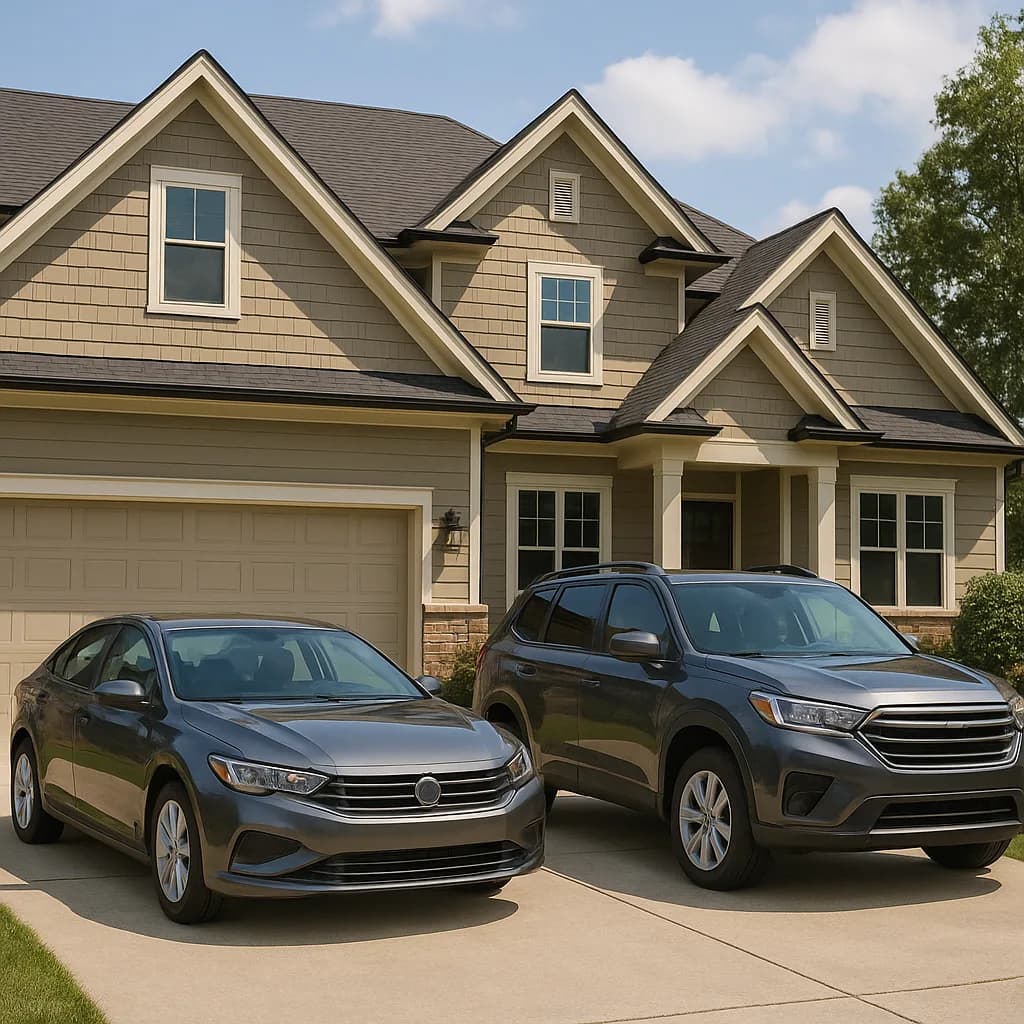
The structural reality: raising deductibles on every vehicle multiplies your potential out-of-pocket cost in a multi-loss scenario. A hailstorm that damages all three cars means you pay three deductibles before comprehensive coverage applies to any of them. That cumulative exposure — not the per-vehicle deductible in isolation — is what you're actually weighing against the premium savings.
Structuring Deductibles by Vehicle Use and Value

Start with the vehicle you drive most. A car that covers 15,000 miles a year in Cheyenne commuter traffic has higher collision exposure than a second car used for weekend errands. Many households keep a lower collision deductible on the high-use vehicle — the one most likely to be involved in an accident — and raise deductibles on cars driven less frequently. The premium difference between a $500 and $1,000 collision deductible is smaller on a low-use vehicle, so the savings-to-risk ratio tilts toward keeping the lower deductible where you need it most.
Vehicle value matters for comprehensive coverage. Comprehensive pays for theft, vandalism, weather damage, and animal strikes — losses unrelated to how you drive. At that value threshold, many drivers drop comprehensive entirely or raise the deductible to $1,000 or higher, accepting that a weather or theft loss on an older car may not justify a claim. Newer or higher-value vehicles on the same policy typically keep comprehensive coverage with moderate deductibles because the gap between vehicle value and deductible remains wide enough to make a claim worthwhile.
Related Articles


Premium Savings and Cumulative Exposure
Raising deductibles lowers your premium because you're assuming more of the loss before the carrier pays. Carriers price the first dollars of coverage more expensively because small claims are frequent; higher deductibles eliminate those small claims entirely, so the savings flatten as deductibles rise.
For a multi-vehicle household, the cumulative savings can be significant. Raising collision deductibles from $500 to $1,000 on three vehicles might reduce your annual premium by several hundred dollars. That's real money. The question is whether you can cover the cumulative exposure if multiple vehicles are damaged in the same term.
The break-even calculation: divide the total out-of-pocket increase (the difference between your old and new deductibles, multiplied by the number of vehicles you expect might file a claim in a given year) by the annual premium savings. Households with clean driving records and low historical claim frequency often find that math favorable. Households that file claims more frequently — whether due to weather, high-mileage driving, or teen drivers on the policy — may not.
When One Vehicle Justifies a Lower Deductible
Not every car on your policy needs the same deductible. A financed or leased vehicle often requires collision and comprehensive coverage as a loan condition, and many drivers keep lower deductibles on financed cars because a total loss triggers a loan payoff where gap insurance may not cover the full amount. The deductible comes out of the settlement check before the lienholder is paid, so a high deductible on a financed vehicle can leave you writing a check to close the loan after a total loss.
Teen drivers and high-risk drivers on your policy change the collision-frequency calculation. A 16-year-old with a learner's permit driving one of your vehicles raises the probability of a collision claim on that car. Many households assign the teen to an older, lower-value vehicle and carry a higher deductible on it — accepting that a collision loss may total the car and the claim may not be worth filing.
Wyoming Multi-Vehicle Carriers
16 carriers
Sixteen carriers write multi-vehicle policies in Wyoming, including standard, preferred, and non-standard tiers. Deductible options and the premium impact of raising them vary by carrier — comparing quotes with different deductible structures across carriers shows you the actual savings and helps you model cumulative exposure.
Modeling Your Household's Actual Exposure
The deductible decision is not hypothetical. Look at your household's claim history over the past five years. How many collision or comprehensive claims did you file? How many vehicles were involved? If you've filed zero claims in five years across three vehicles, raising deductibles to $1,000 or higher and banking the premium savings is a defensible strategy. If you've filed two or three claims in that period, the probability of paying multiple deductibles in a future term is higher, and the cumulative exposure becomes a real cost rather than a remote risk.
Weather patterns in Wyoming matter for comprehensive exposure. Hailstorms, high winds, and animal strikes are comprehensive losses, and a single severe weather event can damage multiple vehicles parked at the same address. If your vehicles are garaged in an area with frequent hail or you park on the street, comprehensive deductibles stack quickly when one storm hits all your cars.
Compare Deductible Structures Across Carriers
Carriers price deductibles differently. The premium reduction for raising a collision deductible from $500 to $1,000 varies by carrier, and the gap widens when you're quoting three or more vehicles. One carrier may offer a larger discount for higher deductibles on newer vehicles; another may price deductible increases more aggressively on older cars. The only way to see the actual savings is to request quotes with multiple deductible structures from several carriers that write multi-vehicle policies in Wyoming.
When you compare, model at least two deductible scenarios: one with moderate deductibles across all vehicles ($500 collision, $500 comprehensive) and one with higher deductibles on lower-use or lower-value cars ($1,000 collision, $1,000 comprehensive). The premium difference between those two structures, multiplied across your vehicles, shows you the annual savings. Compare that savings to the cumulative exposure increase — the total amount you'd pay out of pocket if two or three vehicles filed claims in the same year. That comparison, grounded in your household's actual claim history and vehicle use, is the decision point.